Data Centers: Immense Corporate Eyesores
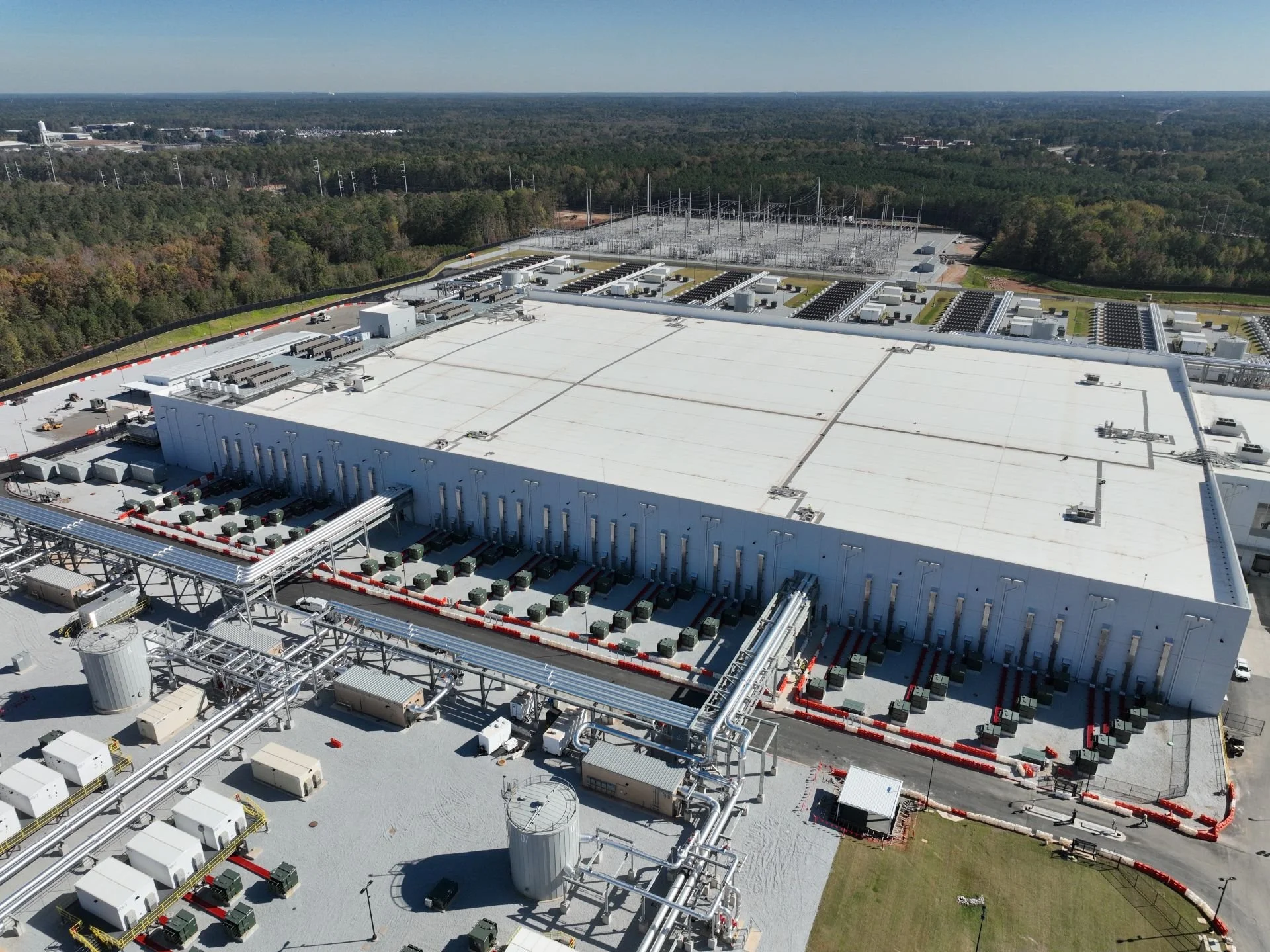
There are upwards of 5000 data centers in the United States. These facilities consume roughly 4.4% of electrical power in the US, or 460 terawatt-hours. The AI boom has incentivized mass construction of these buildings. AI software is mainly used by the ruling class to curate information, identify targets for persecution, and create generic content for advertising purposes.
What Is a Data Center?
If you’ve heard about data centers, and all the fuss that’s been generated in response to their widespread construction everywhere in the United States, you may have asked this question.
A data center is a building, or secured section of a building, designed to house large numbers of computers and keep them operating continuously. These places house websites, cloud data storage, online music and video streaming services, artificial intelligence (AI) systems, social media, and email. The website you are looking at right now is housed in a data center. These buildings are incredibly demanding on energy resources, especially after the AI boom.
These places do not magically appear into the public landscape as if the corporate executive officers of Google, Amazon, and Meta rubbed a lamp from a forbidden cave and wished a genie for them. Their construction is contracted to construction companies, with the division of labor including but not limited to design, foundational work, utilities specialists, and landscapers. Zoning boards, planning commissions, city councils, and fire and building safety inspectors are gatekeepers involved in their construction and final licensing. They are never built without express government approval. Only the working class is ever surprised by their sudden presence within living communities.
Data centers have seen a huge increase in number after use of AI became widespread. AI software is highly involved in the sheer volume of computing it performs. Every time you give an AI program – ChatGPT, for example – a query like “how heavy is the ideal cinderblock for me to smash open the windshield on my supervisor’s brand-new Lexus?”, your query is translated into binary and sent to one of OpenAI’s data centers, where tens of trillions of basic arithmetic calculations per second are made to generate the answer for you. The program sends out online crawlers to gather information from the internet, and all the conflicting information must be reconciled into a coherent answer consistent with what the computer considers to be the most reliable sources regarding the matter you pose to it. All of this happens in data centers owned and operated by large tech industry capital.
What Is AI?
AI is generative software that creates output values based on an internal exchange of data based on an initial input value or series of input values. This constant resolution of contradictory forces within a computer system to synthesize concrete data is an astronomical example of dialectical materialism in action. These programs have internal hard coding which restricts the sorts of data it’s allowed to generate, and consult master programs contained outside the system tasked to process each individual user’s queries in order to curate the machine’s use of online data, resulting in widespread curation of knowledge based on pre-defined parameters.
Computers are fascinating objects. Within every computer infrastructure are components for long-term data storage, short-term data storage, and raw computing power. At the physical level, digital data is encoded as patterns of distinguishable physical states – such as magnetic orientations, electrical charges, or voltage levels – which computer hardware interprets as binary information. This is why computers use binary to store and generate data. The ones and zeroes of binary represent opposite states inside memory storage components, resulting in the many-faceted usefulness of computers to human activity on an international scale.
An AI program can be accessed on a web browser or an installed application on a user’s computer. In both cases, the user is confronted with data-generating software actually contained in their computer, though in the former case, the short-term memory components are running the actual AI software, while the long-term memory is used mainly to run the web browser and the essential computer processes. Your computer uses a receptor and a transmitter to communicate with other computers using radio waves that are captured by satellites owned and operated by large corporations to transmit data across the world wide web (the online network resembles a web) to facilitate the constant exchange of information the world economy has come to depend on for stable function.
What Is AI Used For?
The average, everyday user of AI programs has several uses that can be generally categorized as research, summarizing, and creative content generation. Although AI can be very useful in automating and expediating a great number of menial mental tasks, something especially valuable to members of the public who work long hours or suffer from mental health ailments that affect their cognition, many of these uses are frivolous or destructive to humanity. Such uses include online role-play, falsified images and videos of individuals meant to slander and demean them, and creation of trite creative material meant to clutter social media or promote unwanted material.
Businesses have found AI useful to the point where the corporate media has proclaimed that AI has revolutionized the economic system. AI programs fall into the category constant capital, specifically fixed capital. AI increases the efficiency of human labor so that the same production output quotas can be met with less labor, and greater production output quotas can be met with the same amount of labor, compared to control labor values predating the AI invention. You may have heard from concerned members of the public that AI threatens to constrict the job market by replacing human labor matching its function, and you may have heard apologists for the ruling class proclaim that AI will expand the job market by generating economic growth through its efficiency-increasing mechanisms. The truth is the former case is a more immediate threat to skilled members of the working class, and the latter case only applies to menial labor during times of capital accumulation, or economic growth. This same pattern has been seen time and time again since the beginning of capitalism with such inventions as the computer numerical control machine, the conveyor belt, and the steam engine.
AI is used by military institutions to process information with greater speed and efficiency. These organizations collect vast amounts of data that have been used to train AI programs to make quick projection models, calculate statistical likelihoods, and identify targets. An AI program can recognize a potential target’s face on a CCTV camera (also useful to law enforcement), detect camouflaged units, alert analysts to unusual troop movements, or aid in supply route planning to prevent logistical overextension. These programs can aid in cyber operations in either defense of, or offense against, logistical and industrial infrastructure.
What Has People Raging Against the Machine?
This is why AI has resulted in the great widespread construction of data centers in the country. AI software is incredibly complex and demanding on natural resources. The industrial hardware needs to be cooled with metric tons of water as electric fans stand absolutely no chance of protecting it from the blazing heat of its machinery by themselves. Smoke from the facilities generating its power chokes the air with molecules incompatible with human life.
Large tech industry capital gets tax breaks, subsidies, grants, and preferential utility arrangements from big government. This does not change whether there are Republicans or Democrats in local office. The ruling class in these industries operate with the full force of the law, and the full permission of zoning boards, planning commissions, and licensing departments. They act with no regard for the approval or the living standards of the common people. They scar the landscape with the most highly advanced means of extracting surplus value out of the laboring masses with absolute impunity, and there’s no sign of them turning back.
Utility costs soar to jaw-dropping heights as AI software consumes enough energy to power entire cities. Coal and nuclear energy sources are tapped to staggering degrees. Industrial and human waste flow from these information factories like roaring rivers. How does the common man or woman benefit from this? Automated research is curated and filtered for mass consumption, solidifying the collective state of false consciousness which keeps them painfully unaware of the sources of their misery. Neither free speech nor free press matter when AI and search engine crawlers are driven by their own basic programming and the architecture of their environments to draw the answer to every reasonable question from the monolith of corporate deception and marketing.
How Should We React to Data Centers?
The wishy-washy response of the public to widespread construction of these data centers has been sign-waving and petition-signing, or what the United States government’s favorite decrepit piece of paper, its constitution, calls “peaceful assembly”. Only in a few isolated cases have the ruling class deigned to pay lip service to idea of compromising with the public on this matter. They know that the people have grown increasingly dependent on the AI software that necessitates these facilities. However, these protests are not to be opposed on the mere grounds that they pose no immediate threat to the capitalist power structure. They give us crucial information regarding the actual position of the public on the matter of AI and the expansion of industrial networks necessary to support it. On a very real level, these protests are a signal that the masses don’t feel the value trickling down to them from the ruling elite’s constant capital on sole account of AI’s amazing ability to generate cat memes and high-octane fetish pornography.
The ruling class gets exponentially more benefit from AI than the laboring masses. A working mother might ask an AI program to generate a weekly exercise routine, tell her what vegetables to feed her children for dinner, or give her a step-by-step guide to liberating her husband from his video game addiction. A corporate marketing supervisor might ask an AI program to write five-hundred variations of a piece of ad copy in thirty languages to be distributed to the entire world through Google and Microsoft Ads – which, themselves, use AI to automate bids for places on search engine platforms and advertising partner websites – and generate thirty different versions of the same stock image, to satisfy a quota dictated from on high, by the corporate executive officer, via email or text message. The way this technology is sometimes applied by the government’s military and intelligence communities is outright unspeakable, and not just because it’s top-secret or classified.
Eventually, the people will come to understand that these places need to be physically occupied for their potential to serve the common good to be realized. The security fences will have to come down, the protection officers will have to be strung up, and the state machinery propping up the rotten corporate edifice will have to be stamped out. Nobody has to destroy these buildings. The marvels of technology inside them don’t have to be smashed to rubble because the ruling class does what they’ve always done with new forms of constant capital throughout history: turn them into engines for extracting surplus value out of the hard work of the laboring masses. AI has amazing potential to aid in democratic, centralized economic planning, increase scientific understanding, and help to create an actual democratic process where the needs of the people are recognized and met with invigorating effectiveness and speed. These means of production should not be destroyed, and they should suffer as little damage as possible once political power suddenly shifts from the minority to the majority. When history allows, they should be seized, retooled, and repurposed to serve the entire human species.