Dialectical Materialism Explained – Why God Is An Almighty Lie
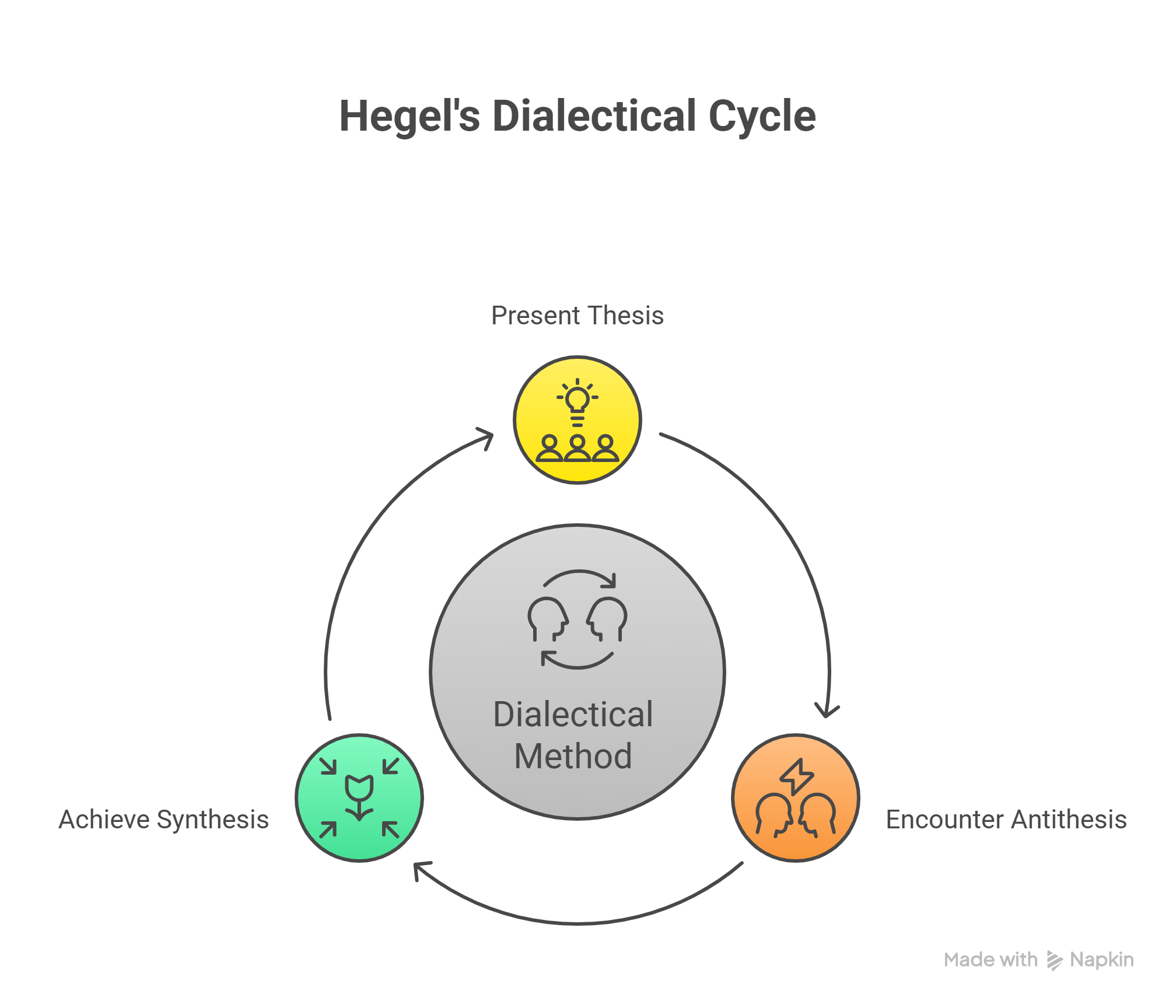
Dialectical materialism is, itself, a synthesis of two great schools of German philosophy. Karl Marx combined the dialectical method of Georg Friedrich Hegel, with the materialist conception of existence postulated by Ludwig Feuerbach, to create an all-encompassing system of understanding which is both wholistic and realistic. The logically consistent structure and dynamism of dialectical materialism has allowed it to stand undefeated in the world of ideology as the world’s most advanced philosophical knowledge.
What is Dialectical Materialism?
There is one thing all those familiar with the basics of science will agree on: all matter moves, even when it appears stationary. Energy in motion through space and time is the composition of our universe utterly, completely, and in absolute. All existence exists, no matter its form, whether it dwells within or without the human mind. The intangible should not be mistaken for the nonexistent. The impalpable should not be mistaken for the supernatural. The incomprehensible should not be mistaken for the divine. Whatever being confronts you with its reality, know first and foremost that it has a material composition, and is both bound and driven by the material conditions which govern its being.
There is no movement without contradiction. Existence in all its forms is in a constant state of contradiction with matter that is simultaneously its opposite and its like. Matter is in a constant state of flux which is cyclical by nature. This is true of matter at every observable scale, from the galactic to the subatomic. Nowhere do we find matter which is not confronted by matter. This ubiquity of contradiction results in the orderly movement of collective bodies of matter which we recognize as the many diverse forms of existence. The vessel which binds matter to the various forms it takes is no metaphysical being or concept that exerts its simultaneously imperceptible and omnipotent will to command its constituent parts to take shape, but matter itself, forming innumerable contradictions within the boundless space which can only be reconciled by constant transformation across the whole of existence.
Everything that exists is made of energy. The movement of matter within systems is what compels it to combine with other matter to form the various bodies of matter which confront another to force its transformation. This constant transformation throughout the whole universe is what creates its complexity and constant circular flux across space and time within its constantly expanding open system. Because matter only is, and only can be, bound and driven by matter, nothing is random, nothing is beyond the collective understanding of humankind, and there is certainly no metaphysical will or being which gives the innumerable bodies of matter their shape or govern their movement. Once this fundamental understanding is reached, the mind becomes enriched with both the knowledge of its bounds and the keys to its agency.
Practical Application of Dialectical Materialism
Matter reacts with matter in ways that are predictable and in full accordance with empirically observed scientific theory and natural law. It is therefore self-evident that matter, including bodies of matter in various states, forms, and sizes, can be manipulated to achieve calculated results. Humanity has been doing this since caveman times, when sticks were rubbed together to create fire, sharpened flint was attached to long sticks to create weapons, and animals were stripped of their skins so those skins could be treated and turned into clothing to warm the body. From these primeval times, humankind has been expanding its understanding of matter manipulation, iteratively transforming itself and its social order to aid in the effective transformation of the material world it inhabits in order to facilitate its continued survival and competitiveness.
Humanity simultaneously cooperates and competes with itself. People form collectives that allow for the organized expression of their manipulative power to transform the matter which surrounds them to better suit their needs. When such collectives confront each other, and find their differences cannot be reconciled through mutual cooperation, they compete. The thing that decides whether groups of people cooperate or compete is the state of material existence which results in the requirements each group has to pursue its desire to thrive and expand. Until these differences are reconciled ultimately throughout human existence, this can only result in one thing: expropriation of a class of laborers by a class of owners and directors. All social conflict in history of a different nature is subordinate to this essential internal contradiction, this class conflict.
The formation of states on the world landscape coincides with the development of private property and the organization of classes based on boundaries of territory. It is not until a ruling class is formed to rule over an exploited class, and this ruling class divides itself from its subordinates along territorial lines, and begins to organize the subordinate classes along territorial lines, that collectives of people which transcend ancestral ties to act according to a unified will are formed. The interaction between states and classes throughout history continues to act in accordance with the basic laws of science and nature. It is therefore possible for people to act on and through states and classes in ways that are predictable by way of recorded experience and credible analysis to secure the collective wellbeing of all humankind. This is the basis of scientific socialism and communism.
The Idealism Marxists Deny
Humanity’s perception of the objective world exogenous to its own mind is bound within a specific framework defined by the tools and knowledge of its understanding. It is therefore inevitable that early history is marked by a mode of understanding predicated on the ideal; the concept of form. According to prior conventional wisdom, it is the metaphysical form of concept which gives body and movement to the whole of existence. In the beginning, these concepts are self-isolated, giving a notion of the divine to the objects themselves. Before the formation of the state, it is sufficient for early understanding that matter takes the shape of metaphysical concept-forms which dwell outside the physical plane of existence. Upon the formation of the state and private property, however, it becomes necessary for this mode of understanding to conform to the organization of the social landscape. In the same stride across history that society is ruled by kings and priests with armies of soldiers and laborers, the heavens become dominated by gods and their minions. As states expand, as the collective will of humanity becomes centralized toward the most dominant constituents of the ruling class, the lesser gods subordinate themselves to the greater gods, until they cease to exist entirely, and the myth of the one god routs all polytheistic notions of existential understanding from the field of social consciousness. Eventually, society becomes so organized, so self-aware and imbued with understanding of the world around it by the constant drive to compete and survive, that it starts to become its own god, and begins to challenge the final vestige of the metaphysical concept-form as the vessel and engine of matter in motion.
Society’s understanding of the origin of matter and its movement through time and space is predicated on its political structure and mode of economic production. So long as there exist ruling classes which direct the organized masses of humanity according to their collective will, an explanation for their continued dictatorship is required which grants the inequitable arrangement a celestial validation which saturates the minds of the masses with the heavy fatalism of an eternal, divinely inspired social order. This is what Marx called the opiate of the masses. An all-pervasive notion of the divinity of the singular agent, the soul-bearing individual whose agency is an expression of an almighty godly will whose power is total, whose knowledge is complete, and whose motives are personal, keeps the masses mentally dull, complacent in the continued dominance of the haves over the have-nots of the world.
In the mode of understanding where the expression of the divine is the soul of man, and the mode of economy is predicated on the production and circulation of commodities, the commodity takes on a divine character. This is what Marx called commodity fetishism, the mythologizing of the commodity as the bearer of an innate, essential character which decides its own value in accordance with the usefulness assigned to it by producers and consumers. It is this commodity fetishism which gives the illusion of humanity’s sole imperative to produce and consume commodities in the greatest mass possible. With rampant consumerism and capital expansion held high, lofty above the collective wellbeing of the species as the measure of good in the whole of society, the gross enrichment of the few and impoverishment of the many is seen as the inevitable will of the divine, metaphysical force which imposes its designs on matter in all its forms. Once this idea is shattered, once the mind is broken free of these chains that bind it to commodity fetishism and the holy sanction of the dictatorship of capital, this disparity of wealth becomes far more difficult to justify. The human spirit rejects its own divinity and begins to become revolutionary.
To Fight God is to Fight Capitalism
Historically, church and state have stood together, hands adjoined, in oppressing the masses with the widespread contaminant of false consciousness. Even in the case where church and state are nominally separate, religious worship is granted state protection, and state functionaries promote religious practices. Rather than any specific god or faith impressed upon the public as the one true path to salvation, religion in general is determined to be a moral and ethical driving force in the social consciousness which results in the good and proper conduct of the social order. This is the essence of bourgeois secularism which has further subjugated religious belief and worship to the self-expansion of capital. The different religious groups become demographics for marketing baubles reflective of their faiths, the common denominators of the different faiths are congealed into a singular secular ethical structure, and the specific, irreconcilable differences between them are bound by law to the requirements of mutual acceptance and cooperation necessary to continue perpetual reproduction of the capitalist economy. The church, in all its forms and with all its practices, subordinates itself to the state because the state, and the state alone, represents the totality of the ruling class.
Secular reactionary elements will proclaim in response to this assertion of objective truth that practices and institutions of faith are supportive of the whole of the public, rather than the ruling class in particular, because they apparently compose a source of general morality necessary for society to function in an orderly and productive fashion. This is nothing but a reflection of their own false consciousness, their own position of reality perception as lost in a wasteland of holy smoke and mirrors. So long as the mind stays bound by the fetters of religious belief, by the concept of reality as a manifestation of some metaphysical concept-form imposing its personal will on the physical world, its self-resignation to the divine sanction of capital dictatorship cannot be beaten. Upon opening of the eyes to the sheer reality that no such concept-form exists, and everything that dwells in the universe is matter which only is, and only can be, bound and driven by matter, the further realization is reached that humanity can – and must – form a moral and ethical standard formed accordingly with its own advanced understanding of the material world.
Religious institutions are parasitic by their very nature. They sell the masses their divine salvation for worship, tithes, and tributes. Immense monuments, stunning artworks, and edifices of deep complexity and great size have been constructed over thousands of years in willingly blind dedication to metaphysical concepts. Acts of unspeakable horror have been committed across the globe, in service to every variety of deity the mind can reckon, at the behest of these institutions and with the sanctions of the state. Social and scientific backwardness is enforced wherever religion is allowed to remain superlative, constraining the behavior of its adherents to the rigid conventions of bygone ages. Great swathes of the impoverished are allowed to fester and grow in the underbellies of civilized society, while priests and temples sit shiny and massive with immeasurable wealth at their state-protected command. This arrangement is incompatible with a free and democratic society where the laboring masses are at liberty to guide their own actions and determine their own fate. Whatever the direction of the masses with regards to religious worship, these institutions of mass expropriation must be annihilated. Upon the seizure of state and economic power by the people in common, the great wealth hoarded by these relics of centuries gone by must be, and inevitably will, be redistributed toward socially necessary economic function and social service. This will put the correct conditions in place for mass enlightenment of the global population away from religion, and into an objective understanding of the material world which is empowering to all who experience it.
Karl Marx and Fredrick Engels have furnished for the world the necessary framework for the wholistic, comprehensive understanding of the material world around it, free of the last vestiges of the concept-form as an executor of will over existence which fettered their predecessors’ own understanding. Dialectical materialism, as a mode of general understanding, is the most advanced, comprehensive, and logical ideology on Earth. It is a doctrine whose sheer force of truth and correctness will one day impress itself on the entire human race.