Remembering and Appreciating the September Eleventh Attacks
Widely regarded as a horrific tragedy to befall the United States public, the 9/11 attacks were not without precedent. Al-Qaeda, the organization behind the attack, had a defined list of grievances against the United States with roots stretching back decades into the past.
What Happened on 9/11?
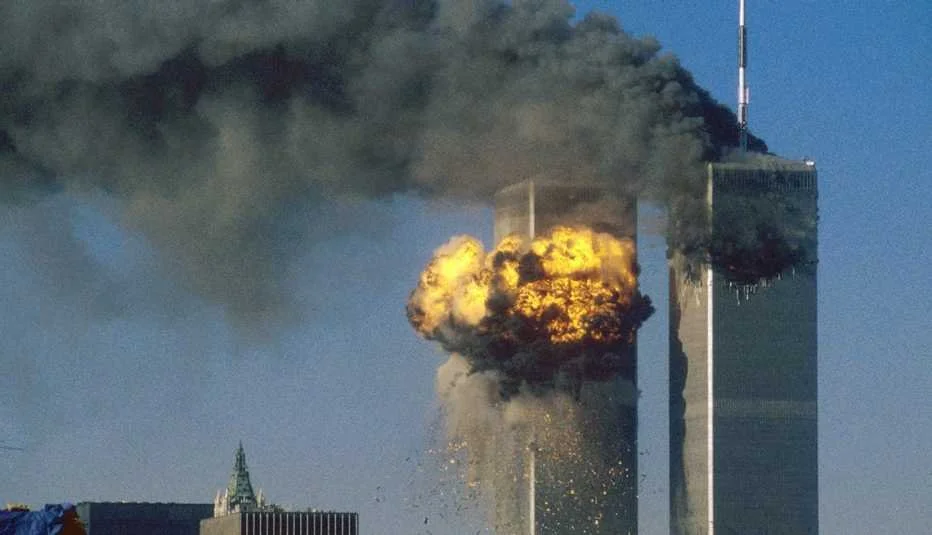
In the morning of September 11, 2001, four commercial airplanes crashed into the northeastern American landscape. At 8:46 am, the North Twin Tower of the World Trade Center in New York City was struck; at 9:03 am, the World Trade Center’s South Twin Tower was struck; at 9:37 am, the western side of the Pentagon, the headquarter building of the United States (US) Department of Defense, was struck; at approximately 10:03 am, an airplane estimated to have targeted either the White House or the Capitol Building in Washington DC crashed into a parcel of land near Shanksville, Virginia. These times are all in Eastern Standard Time. The entire World Trade Center was destroyed as the internal structural damage dealt to the Twin Towers by the airplanes resulted in their collapse, and the collateral damage caused by them resulted in even more buildings’ demolishment. The Pentagon, which at the time was undergoing a full-scale renovation program called the Pentagon Renovation Program, survived the attack, at great cost to this renovation program’s progress.
These airplanes had been hijacked and commandeered by agents working for a radical Islamist organization called al-Qaeda. Despite their training in aircraft flight which allowed them the necessary control over the machines to perpetrate the attack, these men had no regard for their own lives, a regard which was assumed by standard airline protocol at the time to check the inherent danger of any aircraft hijacking. They are reported to have recited the Shahada, translated into English as “there is no god but Allah, and Muhammad is his prophet,” with extreme emphasis as their airborne vehicles closed distance with their intended targets. While the Twin Towers blazed with fire caused by combusted jet fuel from the airplanes, those inside were forced to leap out the windows in hopes that the pavement far below would be more forgiving than the towers’ deadly heat and smoke. This attack on the Pentagon and the World Trade Center, and the attempted attack on Washington DC, resulted in approximately 3,000 deaths. It would change American politics forever.
Al-Qaeda was a transnational radical Islamist organization which had its base in Afghanistan, at the time under the governorship of the Taliban group. Their attack was committed in response to a number of grievances leveled at the US government, having largely to do with its imperialist foreign policy which involved extensive military presence and weapons dealership in the Middle East designed originally to contain Soviet power expansion, but shifted its focus to enforcement of private capital expansion in the region after the Soviet Union collapsed in 1991. Widely credited with articulating this list of grievances is the Saudi-born Osama bin Laden, who officially led al-Qaeda. These grievances have been assembled piecemeal from al-Qaeda’s 1996 declaration of war, the 1998 al-Qaeda declaration, interviews, and later statements. The grievances include US military presence in Saudi Arabia in response to the 1990 Iraqi invasion of Kuwait, continued military and economic aid to Israel, and labor exploitation of native people in the Middle East through private oil companies.
United States Administrative and Policy Changes
A great terror reverberated throughout American society as the shock of the 9/11 attacks bewildered and terrorized the public. President George Walker (George W.) Bush, son of President George Herbert Walker Bush who supervised the US invasion of Iraq through Saudi Arabia a decade earlier, was reading a book to children in an elementary school when he got word of the incident. This was highly publicized and used as a motivational tool of high emotional significance by the corporate media at the time. It was only a month later, on October 26, 2001, when President George W. Bush signed the much-maligned Uniting and Strengthening America by Providing Appropriate Tools Required to Intercept and Obstruct Terrorism Act, or USA PATRIOT Act. This piece of legislation granted the government expanded authority to secretly collect and document information on US citizens regarding every kind of activity and discourse reckonable. While the document was widely condemned and rebuked as a totalitarian peacekeeping measure at the time, today it exerts its power quietly as the next generation emerges from childhood either uninformed or underinformed of its existence, and mass surveillance of the US population by its bourgeois sham government goes on unchecked.
Before the 9/11 attacks, airport security was usually delegated to private security firms. There was comparatively little airport security regulation to safeguard the American public from violent offenders. After the attacks, Congress passed the Aviation and Transportation Security Act, which President George W. Bush signed on November 19, 2001. This resulted in the formation of the Transportation and Security Administration (TSA). Sweeping airline security reforms including stronger cockpit doors, more intensive passenger screening, expanded baggage screening, restrictions on liquids, watch lists, federal air marshals, and increasingly sophisticated explosives detection, extraordinary protective measures at the time, were established. The federal government had basically nationalized the security industry at international airports. Any repeat of the 9/11 flight hijackings became largely impossible when confronted with these changes in airport security.
The US intelligence community at the time had been fragmented compared to the national security threat now perceived by the government. The Federal Bureau of Investigation (FBI), Central Intelligence Agency (CIA), State Department, numerous immigration authorities, Federal Aviation Administration (FAA), and other agencies maintained different databases and operated under different legal and bureaucratic rules. Some of the hijackers involved in the 9/11 attacks had already received attention from US intelligence agencies as people interested in attacking the US. However, inter-agency cooperation which would have resulted in an actionable understanding of the 9/11 plot did not occur. In 2002, the 9/11 Commission would investigate these chronic intelligence failures and issue its final report in July 2004. Congress would establish the office of National Security Director to orchestrate collective intelligence agency action in the US government, and National Counterterrorism Center was established to integrate terrorism-related intelligence and operational planning. Individual agencies within the intelligence community would no longer be allowed to withhold information critical to operations of other agencies’ ability to recognize emerging national security threats.
Operations Iraqi Freedom and Enduring Freedom
At the time of the attacks, al-Qaeda had its center of operation in the country of Afghanistan, where the administration under the Taliban group which allowed them to operate base camps and preserve its leadership infrastructure within their zone of control. On September 18, 2001, Congress passed the Authorization for Use of Military Force, allowing the president to use force against those responsible for 9/11 and those who harbored them. President George W. Bush demanded that the Taliban turn over al-Qaeda leaders, close militant training camps, release certain foreign prisoners, and permit imperialist access to the camps. The Taliban did not comply with the American demands. Al-Qaeda would be allowed to continue its operations unfettered.
Although the Republic of Iraq had been invaded by US armed forces in Operation Desert Storm a decade prior, the Iraqi president Saddam Hussein and his Ba’athist political party were not forced out of power. Saddam Hussein had taken measures to nationalize Iraqi oil industry, something the US government considered a direct affront to American economic influence in the region. Iraq was a member of the Organization of the Petroleum Exporting Countries alongside other oil-producing non-western nations, meaning its oil industry held considerable clout on the global oil market. The country was under United Nations investigation for alleged hidden development of nuclear weapons. Saddam Hussein’s government had already used illegal chemical weapons against Iran during the Iran-Iraq War, and as a tool of genocide against local Kurdish people who were considered a threat to Ba’athist Party administration. It was feared at the time that the Iraqi government would secretly distribute such weapons, called “Weapons of Mass Destruction”, to militant Islamist organizations which would utilize these weapons against the US and its allies abroad, especially Israel.
Unable to secure al-Qaeda containment peacefully, President George W. Bush started a military campaign against Afghanistan on October 7, 2001, called Operation Enduring Freedom, which also included Great Britain and other North Atlantic Treaty Organization powers. Not initially a conventional ground invasion like Operation Desert Storm, the campaign involved concerted efforts from a native Afghan ground force coalition called the Northern Alliance, US Air Force power, Special Operations Forces, and CIA operatives. This unique combination of armed force would succeed in driving the Taliban out of power and crippling al-Qaeda’s viability as a credible threat to US foreign interests. After the Taliban government was dismantled in the region and al-Qaeda moved its operations to mountain bases in Pakistan, the US occupation forces aided in building an Afghan regime more compatible with American foreign policy.
In October 2002, Congress authorized President George W. Bush to use military force against Iraq at his own discretion, and in March 19-20, 2003, US and coalition forces would begin Operation Iraqi Freedom, the conventional land invasion of Iraq from Kuwait. The coalition relied heavily on precision-guided air strikes, armored formations, mechanized infantry, special operations, and overwhelming American air superiority. The famous opening bombing campaign became known as “shock and awe.” Iraqi conventional military resistance collapsed quickly, and Baghdad fell on April 9, 2003. Saddam Hussein had disappeared, only to be captured on December of 2003, and handed to an Iraqi government no longer under Ba’ath Party control. He would be tried in an Iraqi court for crimes against humanity. On December 2006, he was executed by hanging.
Failed Regime Change
It was not until December 2011 that the last of the US occupation forces withdrew from Iraq under the Barack Obama administration. Although the US government had assumed that the new Iraqi state they and local Iraqi leadership they had constructed would be able to survive the tumultuous political landscape as a stable administrative body, this turned out not to be the case. The reformed Iraqi nation was left with a vulnerable government and a weak military which consistently failed to contain al-Qaeda intrusion into their country. Weary of the rising death toll and money cost of the Iraq War, the US was unwilling to renew concerted military efforts to neutralize the militant Islamist threat for the time being. Iraq was left largely to fend for itself.
From the remnants of the old al-Qaeda, the Islamic State of Iraq and Syria (ISIS) was formed. This organization which found new territory and manpower from the Syrian Civil War launched a major offensive into Iraq in the year 2014. With its zone of control spanning large parts of Syria and Iraq, ISIS established a caliphate where Christians were converted to Islam under extreme duress, people sympathetic to western influence were suppressed violently, and Sharia Law was established. That same year, at the request of the Iraqi government, the Barack Obama administration brought imperialist aggression back to Iraq to combat ISIS in the international coalitionist Operation Inherent Resolve. Although the US had provided air support, intelligence services, training, logistical support, and Special Operations Forces support, most of the ground forces set to combat ISIS were ground forces with considerable connection to the Islamic Republic of Iran and its Islamic Revolutionary Guard Corps (IRGC), which provided weapons, advisers, money and organizational support. Semi-independent military organizations with express ties to Iran continue to exert their influence on the Iraqi body politic to this day.
Although US President Joseph Biden is credited with the complete US occupation withdrawal from Afghanistan, it actually began with the Donald Trump administration. In February 2020, the US government under Donald Trump signed the Doha Agreement with the Taliban, who they had opened express negotiations with some time earlier. The Taliban promised, among other things, to prevent groups such as al-Qaeda from using Afghanistan to threaten US national security or foreign interests. The US under the Joseph Biden administration completed the withdrawal in the year 2021. It was not long after that the US-friendly Afghan government was completely abolished by the overwhelming might of the Taliban. Soldiers had abandoned their posts, military officers negotiated private settlements, and the Afghan government prior fled into exile. The newly established Islamic Emirate of Afghanistan began participation in the international community immediately, forming economic and geopolitical arrangements with its neighbors, with the Russian Federation as the first nation to formally recognize its legitimacy as a national governing body on July 3, 2025.
The Legacy Left Behind
The 9/11 attack serves as a historical focal point; a milestone on the US’s long and arduous road from an apologetically wretched imperialist aggressor on the world stage as well as within its own borders, against its own public, to an unapologetically wretched one. Legislation which expressly allows constant domestic surveillance on the American people in the name of counterterrorism means there no longer needs to be pretense for the sham US government to collect sensitive data on its disgruntled populace whose loyalty to it is tenuous as a rule. A legacy of military and intelligence failure which started most famously with the Vietnam War continued unfettered, as it does to this day, with its two successive attacks on the Middle East that, despite costing thousands of American lives and untold millions of US dollars, failed nearly all its primary objectives apart from the initial invasions. A sense of reinvigorated solidarity between every constituent part of the international opposition to the wantonly reckless and shortsighted US government was achieved despite feeble US government attempts to foster widespread regime change friendly to global private capital expansion into economically vulnerable populations. The US military is slowly developing a dual existence as both the nation’s greatest pride, and its greatest shame. Let the legacy of 9/11 serve as a constant reminder that the mythos of the free and independent nation for and by the people, which stretches from sea to shining sea and stands for liberty, life, and the pursuit of happiness, has only ever been a great and monstrous hoax created to mask the sheer corruption and inhumanity of its ruling class.