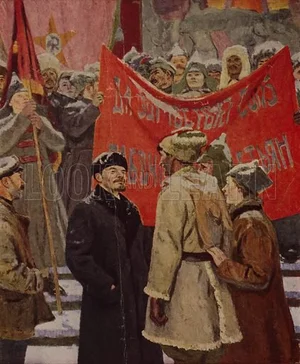
With the right doctrine and the right leadership, there is nothing the laboring masses of the common people cannot do. Whether it is gigantic marvels of architecture, infrastructure, or public service, the decision of which direction humanity should take in its life journey belongs to the people.
Vladimir Ilyich Ulyanov, a great political theorist and hero to the people’s revolution, has often criticized lesser thinkers in his written works for having forgotten or neglected the “ABC of Marxism” when putting vulgar or revisionist ideas forward for practical application. History repeats itself when those who practice power refuse to learn its lessons. If more people would take the time to learn and truly understand the ABC of Marxism, immeasurable amounts of waste in time and labor would be avoided, and study of the finer aspects of the doctrine would bear more fruit.
The following, a quite literal ABC of Marxism, is my attempt to repair this issue:
A = Absolute
There is nothing random in this universe. What we perceive as random is due entirely to the limits of our own perception; uncertainty resultant of those variable factors which are occluded from our view of the world around us on both the individual and the societal level. All existence is material, all material is made of energy, and all energy interacts with other energy in ways that are predictable and determinable by scientific theory and law. Truth, therefore, is concrete, or absolute. However the varied perceptions of the world may be from one or another person, or from one or another people, there is only one objective, material world whose existence is utterly and indubitably without variation as a singular and ultimate whole across the entire body of time and space.
B = Bourgeoisie, Dictatorship of the
In every nation where we find a capitalist mode of production, we find a class dictatorship, a dictatorship of the bourgeoisie, a ruling socio-economic class which holds ownership and management authority over the great mass of the means of production. As capitalism continues to develop, this ownership is centralized to a relatively shrinking number of individuals who form a close fraternity of large business owners.
C = Communism
Marxism-Leninism’s ultimate goal is the global removal of all national and class distinctions. This includes those class distinctions based on race, sex, age, and disability status. The worldwide system of stateless, classless society which Marxism-Leninism seeks to achieve is called communism. The belief system which seeks to establish this global social order, and deems it necessary as an absolute, primary imperative, is also called communism.
D = Dialectics
When witnessing matter in motion through history and time, a prevailing pattern can be observed: Existence moves in a constant state of duality, and in cyclical, spiraling fashion. Energy is bound up with energy that is both its like and its opposite, resulting in the innumerable contradictory forces which make up our universe. These dual contradictory forces, one called the thesis and its opposite called the antithesis, reconcile each other by forming new forces which take on aspects of both thesis and antithesis, called the synthesis, which, by itself, is a form of thesis. This pattern is seen everywhere, in all things, on all scales, and at all times, with no exception whatsoever.
E = Egalitarianism
The Marxist-Leninist belief structure has led its adherents to the scientific conclusion that there is no inherent inferiority or superiority between human beings, and any conception of a particular human being as inherently inferior or superior is based purely on social relation. Marxism-Leninism, therefore, seeks to establish a world society where the social relations between people promote universal equality and respect for the dignity of life as it exists objectively in the material world.
F = Friedrick Engels
From his earliest days until his dying breath, this esteemed sociologist and anthropologist served the international Social-Democratic community as Karl Marx’s close friend and confidant. As a leading figure in both the First and the Second Internationals, Friedrick Engels expanded on many of Karl Marx’s ideas, and penned many of Marxism-Leninism’s foundational literature works. History remembers Friedrick Engels as a man of immense intellectual stature whose loss will continue to be missed for generations to come.
G = Guide
Marxism-Leninism is neither rigid nor dogmatic. Although its key tenets and core principles are strictly defined, Marxism-Leninism demands a careful evaluation of the real conditions of every situation, and dynamic application of the basic framework which it provides to the cause of human liberation. The Marxist-Leninist doctrine is a flexible and universally reliable ideological guide, rather than a fossilized code of laws that breaks down when confronted with any sort of progression or change.
H = Hegel, Georg Wilhelm Friedrick
Both Karl Marx and Friedrick Engels identified themselves with the Young Hegelians in their very early days before adapting his doctrine to Ludwig Feuerbach’s materialist school of German philosophy. Friedrick Hegel identified the world’s course through time as a process of constant change and contradictory forces in motion.
I = Internationalism
The international solidarity of the working masses takes full precedence over all national considerations. Marxism-Leninism rejects all national-chauvinism, and all philistine patriotism which serves the bourgeoisie of one particular nation or another at the expense of the working class. Oppression of one nation by another is to be opposed at all times and in all circumstances, as it always stands opposed to working class solidarity. All nations should have a right to self-determination, and no nation can be truly free so long as it oppresses other nations, as such oppression requires reactionary mechanisms to stay operational and intact.
J = Joint-Stock Company
The joint-stock company, the modern corporation, is how the bourgeoisie takes collective control of the means of production by way of company stock ownership. Finance capital, not merely the lenders of money to industrial and merchant capitalists in the world economy, holds considerable ownership of company stocks, allowing them direct authority over the means of production. Joint-stock companies allow large business owners to engage in wild speculation and risky business ventures with breathtaking amounts of capital at stake, while protected by law from any personal liability incurred by business failures, leaving the negative consequences of such failures entirely to the working public.
K = Karl Marx
One of the founding fathers of Marxism-Leninism, Karl Marx had the largest hand in developing the dialectical materialist philosophical worldview, expanding on the English labor theory of value to provide an intricate and concrete criticism of the capitalist economic system that was once considered infallible, and developed the utopian socialist ideal into a scientific process of social and political development. Karl Marx was a passionate and staunch political activist, having spent his entire life delivering lectures at universities across Europe, writing and editing for newspapers, and generating profound insight into every school of thought that would serve as the groundwork for all future revolutionary ideas.
L = Labor Theory of Value
The labor theory of value is of the three pillars of Marxist-Leninist doctrine, alongside dialectical materialism and scientific socialism. It is based on the premise that the source of all value is labor in the abstract, the general productive force exerted by human hands to build items of use to society. All goods produced have a use-value, and an exchange-value which is both bound up with, and separate from, the use-value in a way that can only be described as dialectical. With regard to commodities, it is the exchange-value that determines the price, the amount of money for which the commodity was produced specifically to attain for the owner of its means of production.
M = Materialism
Marxism-Leninism rejects the ancient Greek notion of the concept-form as the basis for all existence. All forms of religion and god-worship are wasteful and oppressive to the working class. Religion does nothing to explain the creation of the universe or provide the human race with moral-ethical guidance, and only serves to obscure worldly understanding behind holy dogma and divine phrase-mongering. As a humanitarian, scientific doctrine which seeks to emancipate humanity from every kind of oppression, Marxism-Leninism stands opposed to religion and its retrograde, ultra-reactionary mechanisms.
N = Negation
In dialectics, opposing forces in motion confront each other, and as the contradiction between the opposing forces is reconciled, the irreconcilable elements of them are negated, until the weaker force is, itself, negated in the formulation of the resulting synthesis, a new thesis which has taken on elements of both opposing forces as an essential consequence of the dialectical exchange. When this new thesis is, itself, contradicted by a superior opposing force, the synthesis takes a form which is like the old thesis, but different in accordance with the remnant old-thesis elements and the material conditions which ground its existence; this process is called the negation of the negation.
O = Opportunism
Within the far-left political landscape, there always seem to emerge two general trends: on the left, the revolutionary, and on the right, the opportunist. Whereas the revolutionary trend stands unwaveringly by its principles, taking up every form of work necessary to serve the cause of human emancipation, the opportunist will seek to dilute the content of the Marxist-Leninist doctrine while embellishing its form with high-sounding phrases which are meant to sound profound, feel clever, and appeal to philistine dispositions. The opportunist will shy away from any form of work which they believe will hurt their popularity or their tenability as a legitimate political body within the bourgeois framework, dress old ideas in new language to give off pompous airs of profundity, and hypocritically demand that their views be given audience and credence from their political opponents while suppressing opposing viewpoints wherever they find themselves with the power to do so.
P = Proletariat, Dictatorship of the
The necessary phase between the dictatorship of the bourgeoisie and the stateless, classless society is the dictatorship of the proletariat. As long as there continues to exist the physical and ideological infrastructure of bourgeois oppression – things which cannot be removed in one fell swoop, as the anarchists claim, but require many years of concerted, disciplined effort by a democratic, socialist state to remove – no realistic framework for the stateless, classless society can be formed. In this transitory phase, the bourgeois state machinery is smashed, and the proletariat creates its own state machinery to expropriate the expropriators and begin the long work of creating the necessary foundational systems to facilitate the transformation of global society into one where national and class distinctions cease to exist, and the state, itself, withers away in the face of its own superfluousness upon concrete realization of these systems.
Q = Quintessence
The quintessence of Marxism-Leninism is this: Class struggle makes up all history, and the only way to end class struggle is to end the class distinction. The Marxist-Leninist doctrine gives necessary insight into why this is, how this happened, and what can practically be done to fix this problem which lies at the very core of the human condition, but it all begins with this very basic principle of history as a constant internal contradiction within human society between the oppressors and the oppressed, which can only be rectified by forming the ultimate synthesis between the two opposing social forces.
R = Revolution
Coming back to the two opposing trends in the far-left, the revolutionary and the opportunist, it is the latter that rejects the necessity of this imperative, the one of revolution, in favor of another “R”, “reform”. In Marxism-Leninism, the law-abiding form of the human liberation movement is merely an appendage of this movement’s entire body, one which reaches out to the working masses and grants them a channel through which to join the movement. This is different from the reformist trend which sees the work of parliamentary discourse and labor union agitation as the entire scope of the movement, completely losing sight of the objective reality that as long as the ruling class has a monopoly on armed force, the “criticism of weapons” as Marx so succinctly put it, the “weapon of criticism” cannot even hope to penetrate the numerous defensive layers the ruling class has put into place to restrict the working masses to a small array of actionable choices at their disposal to serve their own individual and collective interests.
S = Surplus value
Every object which is a product of labor is an expression of that labor congealed into a material form. Commodities, therefore, each represent a definite amount of labor that has been expended to bring about its production, circulation, and ultimate consumption. Members of the working class receive compensation for expression of their labor-power as socially useful labor expended on commodity production for a definite period of time. As a necessary function of capitalism, these workers are only compensated for part of the labor they provide, as defined by the amount of time necessary to provide it. The uncompensated part, the part which expresses itself in the price of the commodity which is raised to accommodate the reproductive and often accumulation costs of doing business, is called surplus value. It is this surplus value which is the life-blood of the capitalist class, this value for which the capitalist does not earn through labor of their own, and which is circulated in the economy within the ruling class itself, largely unseen by the common laborer as anything useful to them.
T = Tail-ism
This is the tendency of the opportunist elements of the far-left to react to spontaneous developments of the class struggle with blind praise and pandering urges to those working class elements involved to swell the movement with their numbers and join in the singing of their high-sounding phrases. The rationale behind this is that the widespread popularity of the identity of revolutionary will result in profound, sweeping changes in the social landscape entirely through the legal propaganda and agitation work of the opportunistic far-left. Care is taken so as to not offend the ruling class too much for this idealist flight of fancy to take effect materially in the real world. This is a gross misunderstanding of the content of Marxist doctrine at best, and at worst, an outright conscious betrayal of the working class for self-serving agendas.
U = Union, Trade
Trade unions are indispensable to the working class. To a limited extent, they do provide the common laborer with a means of collective bargaining with members of the capitalist class, but more importantly, they serve as channels through which workers can organize, exchange ideas, and make plans for collective action. It is the responsibility of any dedicated revolutionary movement to bring correct agitation and propaganda to the working class through these channels, without making the mistake of limiting the scope of their work exclusively to them.
V = Vanguardism
The revolutionary vanguard is the nucleus of dedicated revolutionary organization and leadership which is responsible for directing the revolutionary activity of the working-class liberation movement. It is made up of the most experienced and knowledgeable revolutionary activists and theorists who guide the constituent parts of the greater movement to optimal strategic performance, making sure that old mistakes are not repeated, mutual cooperation within the overall movement is established, and each leading member has access to the wealth of knowledge and wisdom at the revolution’s disposal. The operational efficiency and security of this model has been pivotal to the worldwide success of those revolutionary movements that have elected to use it.
W = Women’s liberation
Any effort to explain the global class struggle is incomplete without at least brief mention of the sex struggle, the struggle of the marginalized woman against the domineering man. With roots dating all the way back to the establishment of private property, itself, the struggle of womankind against the dominant position of men, often called the patriarchy, has seen the so-called fairer sex struggle against unpaid domestic labor within the nuclear family framework, unequal pay in the workforce, exclusion from suffrage, discrimination in academia and fields of complex labor, and various forms of sexual harassment and violence. As a doctrine whose imperative is to free humanity from oppression in all its forms, Marxism-Leninism stands opposed to the patriarchy’s every form and expression in global society.
X = Xenophobia
This is a term whose dictionary definition is: “an aversion or hostility to, disdain for, or fear of foreigners, people from different cultures, or strangers.” It is generally used to describe an irrational hatred or fear of a person or group of persons on account of their race, culture, or national origin. This is a very old phenomenon that the Marxist-Leninist doctrine vehemently opposes in its pursuit of global working class solidarity and removal of national and class distinctions.
Y = Year, working
General developments and trends within the national social capital tend to be measured in years. This is because the different industries within it have varying lengths of turnover period, the time required to complete the cycles of production and circulation of commodities to realize the conversion of capital investment into the reproductive economic process into profit. The various industries within the economy are interlinked as the main departments of productive capital depend on one another to produce the necessary money and goods to continue economic activity over the nation’s lifespan.
Z = Zeitgeist
Zeitgeist is a loan word from German which means “time-spirit”. It is important to understand that consciousness is built on the framework of collective social relation, and individual characters and belief systems are formed through constant interaction with the social forces at work within the societies in which they are forced to develop. Not all matter is mind, but all mind is matter. Marxist-Leninist ideology is opposed to any conception of psychology or personal agency which is divorced from the tangible, material conditions which make up both the physical body of the thinking organism and the environment with which it interacts.